


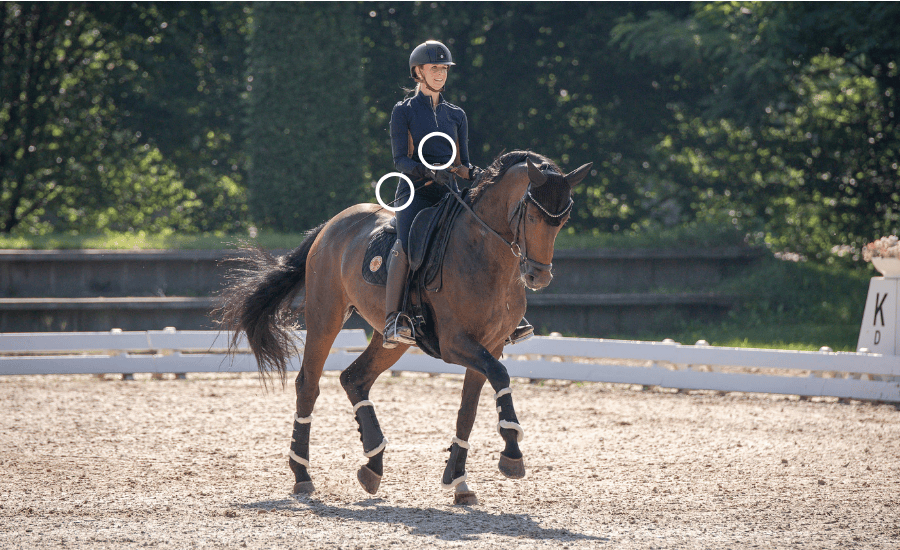
Stable core – Strong center of the rider
Riders need a stable core – Jessica von Bredow-Werndl sums up why in one sentence: “We need a strong center so that we can sit quietly and straight.” That means: Anyone who has strength and stability in their core can absorb, hold, and flow with every movement of the horse. The core is the rider’s center. “It is decisive for whether I can control my body,” emphasizes the Olympic Champion.
A lack of stability in the core leads to the rider tipping forward during transitions from a faster to a slower gait, and falling behind the movement during transitions from a slower to a faster gait. In lateral movements and on curved lines, a lack of stability in the core leads to the frequently occurring lateral collapsing at the hip. These deviations from the balanced seat disturb the horse in its movement and prevent fine and precise aids.
Riders can maximize their performance by developing a certain core strength and stability
In principle, from a sports physiological point of view, the rider can be divided into two “areas”: into an area that he should keep mobile and into one that needs stability. The mobile areas are the hip and the ankle joints, as opposed to the core: “The core should form a stable area, the rider must be able to move arms and hands independently without losing physiological posture. You have to sit relaxed on the horse and have body tension at the same time – that’s the big challenge in dressage,” explains fitness coach Marcel Andrä. “With optimized core stability, riders can control their posture, generate targeted pelvic movements and transfer power along the movement chain. By strengthening the core, riders can maximize the targeted use of the legs.”
In addition, a strong core enables the rider to maintain the optimal body positions in various movement sequences of the horse over a longer period of time. Above all, he can keep his upper body straight and still move with the direction of movement of the horse, without collapsing at the hip. “Ultimately, riders can maximize their performance and improve performance at competitions by developing a certain core strength and stability,” summarizes Marcel Andrä. He also makes it clear that improving core stability is not just about increasing performance: “It makes total sense to focus more often on core strength in training to stabilize weak, injury-prone areas and rehabilitate injuries of the lower extremities. If the core is weak in relation to the rest of the body, the rider gets used to overusing other muscle groups to generate the desired stability with every movement. This sometimes leads to overloading. A well-trained core can be crucial for optimal performance and injury prevention.”
With these three DressurFit® exercises you train your core stability:
Would you also like to become “dressurfit” and receive your own individual exercises to noticeably improve your riding? Then register with DressurFit® via this link and take the first, free test: CLICK HERE!